Showing posts with label Rebecca Mikkelson. Show all posts

Wednesday, March 31, 2021

Editing: Keeping Track of Characters

Wait, didn’t she have blue eyes?

Rebecca Mikkelson, Editor-in-Chief Authors 4 Authors Publishing

I wanted to keep this for the last post because this is a little bit different—it’s more preemptive. Keeping track of your characters will help you edit when it comes down to it, yes, but it will also help you from making the mistakes in the first place. 

The characters in general

Thanks to our illustrious founder Brandi Spencer, I have an information tracker for all of my characters. There is so much information in there that it can sometimes be a little overwhelming, but it’s been invaluable for making sure that I don’t forget names of minor characters or physical features of some of the more frequent characters. 

So what should you keep track of in this section?

Your columns

A lot of times this is information that you as the author will feel very obvious and unnecessary to write down, but let me tell you, you’ll be happy you did if you ever take a sabbatical from your WIP to start another one, or because life gets hectic. And right now, life is very easy to become hectic thanks to the pandemic. So, your very basics should at least be:

  • Names—first, last, and nickname

  • Birthplace—either their country of origin or city of origin, or both

  • Description—this will be their relation to the protagonist(s)

For me, I added a few extra bits of information because I’m keeping track of characters across a series of six books and otherwise, I might forget when the characters appear. These are the extras that I need a little help remembering sometimes:

  • Titles—this is both for the military titles and noble titles, and when they change in the series

  • Books in which they first appear

Physical appearance

My absolute favorite example to give of why it’s important to keep track of physical features both for yourself—and to hopefully share with your editors or publishers to ensure a cohesive picture—and your readers is from Diana Gabaldon’s Outlander series with Dell Publishing. Her main character Claire (Beauchamp Randall) Fraser is very well reported to have whiskey-colored eyes (light brown), but in one of the books her eye color was definitely not the correct one. With this information readily at your fingertips, it will be easier to avoid small mistakes like that. 

I will note, very strongly, that everyone makes mistakes, whether you're self published, published with a small press, or a large publishing company, and these mistakes should not be villainized. Authors and editors alike are human, and there’s only so much you can catch. 

Your columns

I’ll be the first to admit, I’m bad at writing character descriptions and leave them as scant as I can get away with. Unfortunately, you need to know the basics of what your characters look like aside from, “She’s pretty and has brown hair.” So what do you need to look for? Here is what I’ve got to help me keep track of my characters physical appearance:

  • Skin

  • Hair color, texture, and style

  • Eye color

  • Mouth

  • Nose

  • Height

  • Build

  • Distinguishing features

  • Corresponding actor—for those of you who are like me, you might need some visual aids to help you fill out your information or visualize facial expressions on a similar face

Personality Traits

This, I find, is one of the hardest to nail down as an author because a lot of times I want to keep track of characters in “good” and “bad” columns, but that’s just not how the world works in real life, and it’s now how your world should work in your books. Every person has positive and negative traits, and sometimes the positive traits that your characters have are actually negative because of their motivations. These are all the things that make well-rounded characters to make a richer world for your readers. 

Positive

The positive traits are almost always the easiest to come up with because we like to see the good in people. We’re breaking this down into a couple of categories. For your positive traits, you want to look at four things: moral, achievement, interactive, and identity. You might be looking at that list and say, “What in the heck does that mean?” Don’t worry, I’ll give a brief description of each. 

Moral is what influences the mortality of the character, like their loyalty and honesty. Achievement is the characteristic(s) that helps the characters reach their goals, like their adventurous nature, boldness, or curiosity. Interactive is how your characters interact with the other characters in the book, like being flirtatious or courteous. And finally, identity is how the characters truly identify with themselves, like being passionate about things or imaginative.

Negative

For the negative, there’s a little bit less to examine. You want to look at the character’s core flaws and their lesser flaws. There’s also the motivation behind the character’s actions, and you can tie that into both the positive and the negative traits, but I want to tie it mostly into the negative traits because often times we have more motivation for our negative traits than our positive ones, and sometimes our positive traits have negative motivations...which in turn makes them more negative than positive. So what would your core flaw and lesser flaws look like?

Your core flaw is the heart of the matter that will help influence your lesser flaws, like being manipulative and greedy. With these flaws, your lesser flaws would slide into being controlling and inflexible. Things are going to be the way that character wants, no matter what they have to do to get it. 

Now, this is where I think tying the motivations in the negative trait is a lot more useful to understanding the character compared to the positive traits. Let’s take the negative traits listed above and explore some internal and external motivations for why your character is the way they are. Greedy and manipulative could stem from growing up in poverty and wanting to better themselves by any means necessary, such as manipulating others and hoarding wealth so as not to lose it.


If all this sounds great, you can download a blank copy here.


Join us in two weeks when we start a series on another branch of editing: Continuity. 


Let's Keep in Touch!

Follow us on Facebook and Twitter to keep up to date on our books, authors, and more!
Can't wait? Check out our website for available books!

Wednesday, March 17, 2021

Editing: Cutting the Fat

Snip, snip, snip.

Rebecca Mikkelson, Editor-in-Chief Authors 4 Authors Publishing

Ironically, I already cut the fat from this blog series. Originally instead of the three posts, there were going to be four, one of which covered unnecessary words and phrases. You’ll notice that it’s one of the sections in this blog post. Cutting the fat doesn’t necessarily mean you have to get rid of everything, but that you must trim it down to be more purposeful.

Kill Your Darlings

In our Misused Writing Advice series last year, we had a post about this you can read here. As you’ll read in the post, killing your darlings isn’t about killing off your characters. (Though you might need to do that too.) These are the scenes or large sections that don’t add to the plot or character development, no matter how much fun you had writing them. They will weigh down your novel and make it more difficult for your reader to get through your work. 

One really good example of this is getting attached to a chapter in another character’s POV that could be easily summarized in a paragraph. Let’s call these Character A and Character B. Character A has the main POV through the book, but Character B has a chapter where they witness some important information happening. It’s great that we have the information, but because the reader and Character A only need that bit of info to move the plot forward, we don’t need to have a 3,000 to 4,000 word chapter to give a paragraph’s worth of retelling.

Like in the dialogue post, each scene and bit of information must have a point. It absolutely must push the plot forward toward the conclusion of the book or the series. There might be some bits that you can recycle that would be better in smaller chunks or even in another book, and please, by all means, do it. 

Just don’t be afraid to take out the knife and slice away because you’re too attached to a scene. 

Get Rid of the Clone Army

No one likes killing characters, except maybe George R. R. Martin because he subsists on his readers’ tears. In this section, however, I’m not talking about killing off characters that drive the plot forward or give your protagonist a driving point, motivation, or affects their character arc. I’m talking about the characters, or the Clone Army, that just in general don’t need to be there because they’re redundant, don’t drive the plot forward, or really make any difference whatsoever to your protagonist, or even antagonist. 

Your first thought might be going to the “sexy lamp test” that was proposed by comic book writer and editor Kelly Sue DeConnick, but those characters are better served by developing their characters rather than taking them out. If you haven’t heard of this test, Sexy Lamps are usually female characters who do nothing to affect the story by their actions and could be replaced by an inanimate object with changing the plot.

A great example of this is right in one of our founder’s own works. In book two, Kiss of Destiny by Brandi Spencer, she combined the roles of the captain of the guard and the prison warden into a single character because one was redundant and didn’t need to be there when the second character could do the job of both without feeling the loss of either one. 

Another example is when you’ve got a character that shows up only for a scene or two that doesn’t play a role in later books in your series disseminating information but there’s a way for an established character that does affect the plot to give this information instead, get rid of the dead weight.

Unnecessary words

Remember that recycling I talked about in the first section? Well, here’s a great example. I’m recycling an entire blog post into here. 

Let’s talk a little bit about unnecessary words: they shouldn't be there unless they’re in dialogue and it’s the way your character speaks. There are plenty of us out there that don’t speak with the eloquence most of us strive for.

There are two categories that I think all authors need to look at in their edits. The first is looking at a sentence and seeing if you can say the same thing with fewer words while still conveying the same meaning. If you can, cut those words. The second is using the find function and getting rid of words like: 

  • That

  • Just

  • Like

  • Probably

  • Most likely

  • Literally

  • And your hedging verbs that don’t need to be there for anything other than clarity.

Redundancies

Redundancies are one of the first things that I look for when I get a new manuscript from our authors to nip in the bud. These are things that we all put into our manuscripts without thinking, but once you review them, they’re implied. Here are a couple of examples of phrases I take out to make things more succinct and take out the implied portions. 

He shrugged his shoulders. → He shrugged.

He nodded in agreement. → He nodded. 

He stood up. → He stood.

He sat down. → He sat. 

All of these can also be combined with whatever sentence is coming next.  For example:

Shrugging, he went into the next room. 


Join us in two weeks for the final blog in this mini-series where I talk about keeping track of your characters. 


Let's Keep in Touch!

Follow us on Facebook and Twitter to keep up to date on our books, authors, and more!
Can't wait? Check out our website for available books!

Wednesday, March 3, 2021

Editing: Cleaning Up Dialogue

Rebecca Mikkelson, Editor-in-Chief Authors 4 Authors Publishing

Ahh, the dreaded dialogue. I wanted to start with editing your dialogue because it’s simultaneously the easiest and the hardest thing to do. A lot of us struggle writing dialogue in the first place, and now we’ve got to edit to make it better? Gross. 

You don’t need every dialogue tag

Let’s start with the easiest part of cleaning up your dialogue, and that’s with the tags. 

What purpose do tags serve, you ask? Well, their most important purpose is to easily let the reader know who is speaking. It also lets the reader know how the character is speaking—but these aren’t always necessary. Let me give you a few examples of what I mean and how to clean them up.

“I can’t stay here anymore!” Alan yelled. “I can’t take it—I’m leaving.”

Now we know who’s talking in here, but Alan yelling is implied by the fact there’s an exclamation point. You’re better served by either taking out the dialogue tag altogether or using an action beat instead.

“I can’t stay here anymore!” Alan grabbed whatever he could and threw it into the open suitcase. “I can’t take it—I’m leaving.”

It’s more effective for setting the tone of the scene and how frustrated Alan is while he’s planning on leaving. Now let me give you a less clear example of where you can either keep or change the tag: 

“What do you mean you’re leaving?” Charlotte asked quietly, her lip quivering. 

If we take out the qualifier of asked, the dialogue tag becomes redundant and we don’t need it. But, with that qualifier, it’s telling us the intonation in which she asks, and becomes a little more important. However, I’m still a believer that it can always be improved:

Charlotte’s lip quivered. “What do you mean you’re leaving?” 

This cuts the unnecessary dialogue tag while still, to me, implying that she’s saying something quietly because she’s emotionally distressed. And don’t be afraid to move your action beat or tags around to make your dialogue more impactful!

Tone

Tone is one of the harder ones to fix, because it’s often a more pervasive problem throughout an author’s manuscript. Your characters need to have their own developed voices so that they become distinguishable from each other, and if there’s a narrator, the narrator’s voice. This is not only important for the readers, but the author to develop story arcs and series arcs for the characters.

My suggestion for keeping track of this is to create a character sheet with basic information about their personality and character arcs planned throughout the book or series so you can easily reference what kind of character they are.

Context matters

The context in which your characters speak to each other really matters. If you have a mother and daughter talking to each other, they might be a little more blunt and gossipy as compared to coworkers or people they’re trying to flirt with. Switching back and forth between the two might make it feel like there are some character discrepancies, so looking at the context in which things are said will help you determine if you’ve created a problem you need to edit away.

What’s the point?

Every piece of dialogue needs to have a point. While people will talk to fill up the space, your characters shouldn’t. Every bit of their dialogue should serve a purpose to move the plot and their character development forward. 

The biggest test of whether or not you’ve written your dialogue with purpose is if you can remove an entire scene of dialogue, or a sentence here and there, and the plot will remain the same. 

Keepin’ it Real

The way that we speak in real life is not the way that our characters talk in books—and for good reason. Truly realistic dialogue is going to sound inane and not going to interest your reader into “listening” to a conversation they could hear on the street or in their own living room. Like mentioned in the previous section, your dialogue must have a point that moves the plot forward. 

So when you’re going through your edits, take a close look at your dialogue and if your characters are stumbling over their words without purpose (like they’re naturally shy speakers and can’t get through a few sentences without saying um or pauses), take it out or change it to have purpose. 


Join us in two weeks for our next post in this series where I talk about cutting the fat.


 Let's Keep in Touch!

Follow us on Facebook and Twitter to keep up to date on our books, authors, and more!
Can't wait? Check out our website for available books!

Wednesday, February 17, 2021

Editing: Overview

A Necessary Evil

Rebecca Mikkelson, Editor-in-Chief Authors 4 Authors Publishing

Editing. It’s the bane of every author’s existence—aside from the inability to put perfect words to paper the first time. We’ve previously talked about editing before in a nonserial post, but we wanted to talk a little bit more about the more specific parts of editing. Over the next three posts, we’ll talk about some of the biggest parts of your editing passes. 

After each post goes out, we’ll update this post with links for easy navigation.

Cleaning Up Dialogue

I wanted to start with editing your dialogue because it’s simultaneously the easiest and the hardest thing to do. A lot of us struggle writing dialogue in the first place, and now we’ve got to edit to make it better? Gross. In this post I’ll talk about how you don’t need to use dialogue tags all the time and give several examples of how you can use action beats instead, add tone for your characters that make them unique, contexts in which your characters might feel like they’re out of character when they’re not, and purposeful dialogue. 

Cutting the Fat

Ironically, I already cut the fat from this blog series. Originally instead of the three posts, there were going to be four, one of which covered unnecessary words and phrases. In this post, I really practice what I preach, which I think is important if we’re going to be doling out guides for public consumption. Cutting the fat doesn’t necessarily mean you have to get rid of everything, but trimming it down to be more purposeful. In this post I talk about killing your darlings—and what that really means—and when you can combine characters to avoid being redundant, and getting rid of unnecessary words and phrases that are implied by the context or statement in general.

Keeping Track of Characters

I wanted to keep this for the last post because this is a little bit different—it’s more preemptive. Keeping track of your characters will help you edit when it comes down to it, yes, but it will also help you from making the mistakes in the first place. In this post I’ll talk about your characters in general, like where they come from, their physical appearance, and personality traits. It might seem like boring and obvious information when you get down into the nitty gritty of everything, but this will be an invaluable resource for authors and editors alike to keep the mistakes as few as possible. 


Join us in two weeks for our first post in this mini series where I talk about cleaning up your dialogue.


Let's Keep in Touch!

Follow us on Facebook and Twitter to keep up to date on our books, authors, and more!
Can't wait? Check out our website for available books!

Wednesday, December 30, 2020

Another Year in Review

What a Year It’s Been

This is going to be our second installment of us looking back on our year. If you want to read the first, you can find it here. We want to keep this tradition going for every year we’re a company, because we believe it's important to look back on what we’ve accomplished and what we could do better in the following year. 

This year has been hard

First and foremost, we can’t talk about the year without addressing one important thing: it’s been extra hard with a world-wide pandemic going on. We’ve been incredibly fortunate to still have a healthy business while people have been cutting back on their spending habits; we know others have not been as lucky. This pandemic has impacted everyone from the top to the bottom—even one of our founders and her family suffered from a case of COVID-19 at the start of the pandemic. We do genuinely hope that, for those that are still buying our books, we’ve brought a little joy in their lives during an incredibly stressful and scary time.

Some hard decisions

As we talked about last year, publishing is hard. It’s still hard, and with the turmoil and stress of the year, we've decided that we want to funnel our time and attention into fewer books, allowing us as a company to take the time needed to fully develop each book. To that end, we only published eight books this year, and plan on publishing six books per year going forward.

Our Authors

One of the reasons that we’ve managed to stay successful this year is our wonderful authors. Without them, we’d be nothing. That might sound dramatic, but it’s the truth. We have some of the most understanding and caring authors working with us. We couldn’t be more thankful for the ones that have who keep wanting to come back to us year after year. 

Last year, we talked about our very first author who took a chance on us. This year we want to talk about the author that has the most books planned with us: Lisa Borne Graves. She currently has two series running with us, and a third one planned after another finishes.

Lisa Borne Graves is a YA author, English Lecturer, wife, and supermom of one wild child. Originally from the Philadelphia area, she relocated to the Deep South and found her true place of inspiration. Her love for all literature, led her to branch out from the academic arena to spin her own tales. Lisa has a voracious appetite for books, British television, and pizza. Her inability to sit still makes her enjoy life to its fullest, and she can be found at the beach, pool, on some crazy adventure.

We would highly recommend following her on Facebook or Twitter (or both).

Our Books

Our publishing schedule has booked up far quicker than we ever expected, to the point that we don’t know when we can open back up our submissions to new authors again. We can’t wait for everyone to read the books we have out from the previous year, but this year as well. We’ve really had a great bunch of books come out in the romance and fantasy genres. 

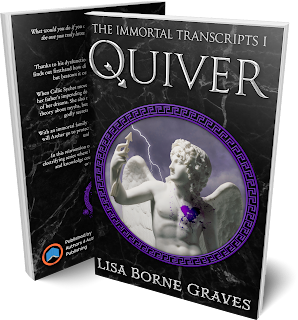
As with our author section, we want to feature Lisa Borne Graves with one of her books that came out this year: Quiver, the first book in Lisa’s Immortal Transcripts series.


What would you do if you could live forever? Could you hide it from the one you truly loved, especially if her life depended on it?

Thanks to his dysfunctional Olympian family, Archer Ambrose finds out firsthand how difficult this can be. He never falls in love but bestows it on others—until he meets Callie.

When Callie Syches moves to the Upper East Side to prepare for her father’s impending death, she doesn’t expect to meet the boy of her dreams. She also never believed her father’s harebrained theory about myths, but her uncanny ability to “see” uncovers godly secrets Callie can hardly fathom.

With an immortal family demanding absolute obedience, how far will Archer go to protect his love from the storm the gods will unleash upon them?

In this reinvention of Cupid and Psyche, experience an electrifying series where familial and romantic bonds are at war, and knowledge could mean the end of everything…or a new beginning.

Our Blog

Last year our blog didn’t get any attention in our review post—there was a reason for that. We were still developing our blog and figuring out whether it was worth keeping up the effort. 

Well, I’ll tell you, it has been. It’s the perfect opportunity to show that yes, we do know what we’re about. We’ve been able to pass on a lot of our knowledge since we started writing our blogs, and we’ve learned even more while researching for some of them. As much as we’re enjoying writing our blogs, we’ve also decided to decrease the number we’re putting out each year to make sure that the quality is as good as possible.

Series from the last year

We like to try to do a couple of series per year where we cover a lot of subjects to help the Writing Community no matter what stage they are in in their publishing journey. 

Misused Advice—in this series we explore advice that’s great at its core, but has evolved over the year to be absolute and seemingly inviolable advice that’s followed by writers and instructors alike. We wanted to rock the boat and say some of these rules you don’t have to follow simply because most people think you have to.

New Authors—in this series, we started back at the basics for authors new to writing and the writing community. We cover the seven biggest things you need to know and develop in your work to really make it successful: plot, characters, dialogue, setting, world building, themes, and conflict.

Plot Archetypes—in this series, we talked about the seven basic plot archetypes in any story. We wanted to have another series this year that really focused on the building blocks of writing for our newer writers. We often quote the wise words of Richard Bach, “A professional writer is an amateur who didn't quit,” because we want to encourage every amature not to quit. And we think sharing the building blocks of the craft will help. 

Favorite from this year

There are a couple of blog posts that I’ve really enjoyed writing, but my absolute favorite from this year was one I wrote with cofounder B. C. Marine: I’m Feeling Conflicted from our New Authors series. In this blog, we wanted not only to talk about conflict, but bring it off the page by having conflict between the two of us. 

We might be arguing in the blog post, but I can assure you, it’s the most fun I think either of us has had writing a blog. We sat in a Google meet giggling like children the entire time. 

Final Thoughts

This year, like last, was hard. It’s hard to be in a job that has endless hours, sometimes little thanks, and a lot of the time more frustrating than one might expect. 

But would we choose another profession? No. 

No matter how hard it gets, there’s no better feeling than helping an author achieve their dreams of going from unpublished to published. There’s a unique joy in being the one to do that, and it’s the joy we hold on to tightly when the going gets tough. 


Join us next year when we start a new series on editing.


 Let's Keep in Touch!

Follow us on Facebook and Twitter to keep up to date on our books, authors, and more!
Can't wait? Check out our website for available books!

Wednesday, December 2, 2020

Plot Archetypes: Rebirth

It’s all about the arc, baby

Rebecca Mikkelson, Editor-in-Chief Authors 4 Authors Publishing

Welcome to our sixth and final post in our plot archetype series! Today we’re going to be talking about the feel-good plot archetype: rebirth. So what exactly is involved in this plot archetype?

What is it?

Well, rebirth can literally be a resurrection, but in general, it’s a transformation of your main character from villain to hero. The whole cast of characters wins when you have a rebirth plot because the protagonist changes themselves and their surroundings for the better. After sinking further into their vice or villainy, these characters will meet a character that reminds them of the goodness of the world and inspire them to change for the better. 

How to write a rebirth plot

So how do you go about writing a rebirth plot? Well, like the other plot archetypes we’ve been talking about, there are certain steps that need to be taken in order to make it successful. So what are they?

The fall of the protagonist: Your protagonist can’t have a redemption arc without first needing to be redeemed, right? This is where it’s established that your protagonist has fallen off the righteous path and the reason why they fell.

Bad is a good color: Your character’s bad deeds have to work for them, or else why would they stay bad? This could be something like insider trading and your character getting super rich, or they killed someone to take over a kingdom and they have the world at their fingertips. 

Frustration: This is where your protagonist sees that they might have done the wrong thing, but they don’t yet see how they can get out of their situation.

Nightmare: This is where your character will feel there’s absolutely no way out—there’s no changing for them; they’ve gone too far down the hole and they should just stay there. 

Redemption: Remember the aforementioned character that shows them they can be better? This is where they’re really going to shine. Your protagonist is going to realize that they can change with the help of or inspiration from the helper. And they do the hard work to make amends and improve themselves to no longer be the villain.

Examples

So, where can you find plots that involve rebirth? Well, there are several different examples that we can give, so we’ll break them down into books and movies for this blog post.

Books

A Christmas Carol is a book we’re all familiar with—especially since we’ve gotten so many movie versions of it. This is all about Ebenezer Scrooge and his journey to redemption. After a not so bright childhood with a lost love, Scrooge becomes the miser that we see from the start of the book. After he’s visited by the ghosts of the past, present, and future and sees how miserable his life is and how miserable he makes everyone else, a fire to change lights under him. He doesn’t want to die alone and unloved. So when he wakes up from his nightmare of visions, he vows to change his ways—and does. And everyone around him benefits from his new generosity, but especially the families of his workers. 

Movies

How The Grinch Stole Christmas is a family classic that, at least in my family, is played nearly every year around or on Christmas. To be fair to the Grinch, he doesn’t really hate Christmas—he hates the people that treated him poorly. This is where the book and the movie differ slightly: Cindy Lou Who, instead of catching the Grinch in the act of stealing their Christmas feast and presents, decides to befriend the Grinch and warm his heart to the Christmas spirit by trying to get him elected as the Cheer Meister. And she almost succeeds until the town mayor proposes to the Grinch’s childhood love and  the Grinch wreaks havoc on the town destroying the things around him. After being hated and derided by the villages in Whoville, the Grinch decides to take his revenge and ruin the one thing they love most: Christmas.  And so he takes the villagers’ gifts and feasts and plans to get rid of them so no one can have a happy day. But come the morning, despite him stealing everything, he hears the Whos singing and realizes that Christmas isn’t just about the gifts and the feasts, but the people. And as the story goes, his heart grows three sizes and returns the gifts to the villages and they all live happily ever after. 

Join us next week for an author interview with A4A author Melion Traverse about her debut novel, Exile.

Let's Keep in Touch!

Follow us on Facebook and Twitter to keep up to date on our books, authors, and more!
Can't wait? Check out our website for available books!

Wednesday, November 4, 2020

Plot Archetypes: Tragedy

The books you cry over

Rebecca Mikkelson, Editor-in-Chief Authors 4 Authors Publishing

Welcome to our fifth post in our plot archetype series! Today we’re going to be talking about a story that’s familiar to everyone who’s ever taken a high school English class: tragedy. So what exactly is involved in this plot archetype?  

What is it?

Unlike a comedy, a tragedy is a series of bad decisions that don’t end up having a funny, happy ending. It ends, well, in tragedy. There are no happy endings for this type of plot, especially for the protagonist. This might sound a little sad, and it is, but our protagonists in tragedy stories usually aren’t truly heroes like we would see in our other plot archetypes. They’re tragic heroes who do not have to be entirely good or evil, but they tend to fall further into the evil side than they do good. We can also see heroes turned into villains based on discontentment of how they’re treated who now do everything that they can to ruin things for their former allies or heroes. (Think Benedict Arnold after being passed over for promotion several times turning his coat to the British.) 

How to write a tragedy plot

Much like the other plot archetypes that we’ve been looking at, there are five stages an author must hit in order to write a successful tragedy plot. So what goes into it? 
Anticipation Stage: This is where our tragic hero discovers something that they want and set their sights on getting it. This could range anywhere from money to power to the girl they want to marry. No matter what they set their sights on, by trying to attain it they start their own downfall.

Dream Stage: This is where the protagonist starts their journey toward their goal, and by ignoring any warning signs that what they’re doing is wrong, they will do something that means they can’t change their mind and turn back to their old life. Things are going to go right for them, at least for now, and they’re going to see this as a sign that they’re doing what’s right. 

Frustration Stage: Some things are going to start going wrong for the protagonist, but they are able to overcome them and continue on toward their goal, and what they do will truly alert the reader that there won’t be redemption for the tragic hero by the end of the book. 

Nightmare Stage: Now nothing is going right and the protagonist’s plans start failing. They keep making bad decision after bad decision that has them living in fear of the eventual failure.

Destruction Stage: This is where everything comes to a head and the protagonist ultimately fails in their goal, or at the very least loses everything that they’ve gained. Sadly, or not so sadly, this is where the protagonist will perish and the other cast of characters will be rid of the evil put forward by the tragic hero.

Examples

So, where can you find plots that involve tragedy? Well, there are several different examples that we can give, so we’ll break them down into their own sections, but this time we’re going to focus on books and plays. 

Plays

King Lear is just a cluster of bad decisions. First, Lear splits his kingdom into three between his daughters equally and he asks his daughters how much they love him. When the youngest doesn’t give him the kind of answer he wants, he disowns her and she goes to France to the French king. After that, Lear realizes the mistake he’s made but there’s no getting out of it now. He flees to the heather after his remaining (remaining as in still in the same country) daughters undermine him out of what little power he still has. After that is a series of bad decisions on the daughter’s part that result in their deaths and King Lear dies from grief. In this play, not every bad decision is made by our tragic hero, but the decision he made put everything into motion to have the result that it does.  

Books

Madame Bovary is perhaps even more tragic than King Lear. In this, Charles Bovary first loses his wife, and then marries another who is discontented with life as a village wife. She wants the finery that she sees wealthier people have and falls in and out of love with wealthier men, making her husband a cuckold, and also falls into extreme debt with a money lender. Eventually she ends her affairs and when the moneylender repossesses the items that she can’t pay for. Afraid that her husband will find out, she tries to pay back her debts by asking local businessmen and even trying to prostitute herself to one of her ex-lovers. When that doesn’t work, she kills herself by eating arsenic to avoid the shame of her own greed. To make the story even more tragic, her husband was so loyal he never suspected she had been unfaithful until he found her letters to her ex-lovers after her death, and he dies from his own grief. 


Join us next week for an author interview with A4A author and co-founder Renee Frey for her debut novel, One Thousand and One Days, a retelling of One Thousand and One Nights, and in four weeks we’ll see the conclusion of this series when we talk about the rebirth plot archetype. 

Let's Keep in Touch!

Follow us on Facebook and Twitter to keep up to date on our books, authors, and more!
Can't wait? Check out our website for available books!

Wednesday, October 28, 2020

Misused Advice: Avoiding Tropes and Clichés

Can they really be avoided?

Rebecca Mikkelson, Editor-in-Chief Authors 4 Authors Publishing

Every piece of advice that we talk about in this series has good intentions at its origin but has evolved into something either misused or inviolable. Today’s advice to avoid tropes and clichés is slightly different in that we agree…but only to a certain extent. 

What is a cliché?

First, I think we should discuss what a cliché is. According to Merriam-Webster, cliché (noun) has three definitions but only two pertain to this post:

1: a trite phrase or expression (also: the idea expressed by it)

2: a hackneyed theme, characterization, or situation

So, for example, a phrased cliché would be “avoid it like the plague” or “blood is thicker than water.”  And examples of the latter definition would be the Mary Sue or Marty Stu (which you should absolutely avoid at all costs) or the brooding rebel.

What is a trope?

You might be wondering why we’re including tropes in this post because some tropes are good and provide structure…at least by trope’s morphing definition, which is commonly attributed to recurring literary devices and rhetorical devices. Isn’t language fun?

But…by its definition from Merriam-Webster, a trope is a cliché:

1a: a word or expression used in a figurative sense: FIGURE OF SPEECH

b: a common or overused theme or device: CLICHÉ

2: a phrase or verse added as an embellishment or interpolation to the sung parts of the Mass in the Middle Ages

So when I say a trope is a cliché, I mean a badly written trope. Examples of good and bad tropes would be friends to lovers or the unlikely hero and the dreaded love triangle or instant love (love at first sight).

How did this advice start?

I can’t find exactly who this advice started with as we’ve been able to with some of our other misused advice posts, but I can take an educated guess: the need for originality. 

Originality is key for making a good book; readers don’t want to read the same thing over and over again, right? However, this advice is completely ignoring the fact that we authors are creative and find new ways to do things. 

Should we really be avoiding them?

Now here’s the big question, should we be avoiding cliches and tropes or should we keep using them over and over? Well…the answer is a little bit complicated, so let’s break it down into two sections: should and shouldn’t.

Why you should avoid them

So here’s where this post is going to differ from our other posts where we disagree with the vehemence of the advice, because in this instance we only half agree with the vehemence. Employing overused tropes can make the book feel predictable and the author seem lazy, which is death to any book.  

It’s unfortunate to put it so harshly, but it’s true. The experience of reading a good book will be  ruined by a book being too predictable. Reading should be an adventure. 

As for clichés specifically, using them could confuse international or non-neurotypical readers because they won’t make sense in other nations or cultures, may be too rooted in social understanding for a non-neurotypical person to decode, and oftentimes they’ve been repeated incorrectly so many times that they no longer make sense. For example, “You can’t have your cake and eat it too.” You can. You absolutely can have your cake and then eat it. This cliché should be: “You can’t eat your cake and have it too,” because you can’t both consume and possess something at the same time. 

Why you shouldn’t avoid them

Authors are creative, and we can find ways to refresh and invigorate ideas with new twists. If we couldn’t, literature would have died out centuries ago because we’d have run out of stories to tell. Of course we want to read about the hero vanquishing the evil and the band of friends that help them do it. And of course we want to read about the friends that fall in love by the end of the book.

With clichés, just the same as they can alienate some of your readers, they can bring them together as well. And they can give quick insight into what’s happening with the characters, such as when a character becomes pregnant quickly saying, “You’re eating for two,” makes it absolutely apparent the character’s condition. They can also make some of your readers feel like they’re at home.


This post may seem a little contradictory, and it is, because the subject in itself is contradictory. For this one, there is no right answer. 


Join us next week as we resume our series on plot archetypes when we talk about tragedy.


Let's Keep in Touch!

Follow us on Facebook and Twitter to keep up to date on our books, authors, and more!
Can't wait? Check out our website for available books!